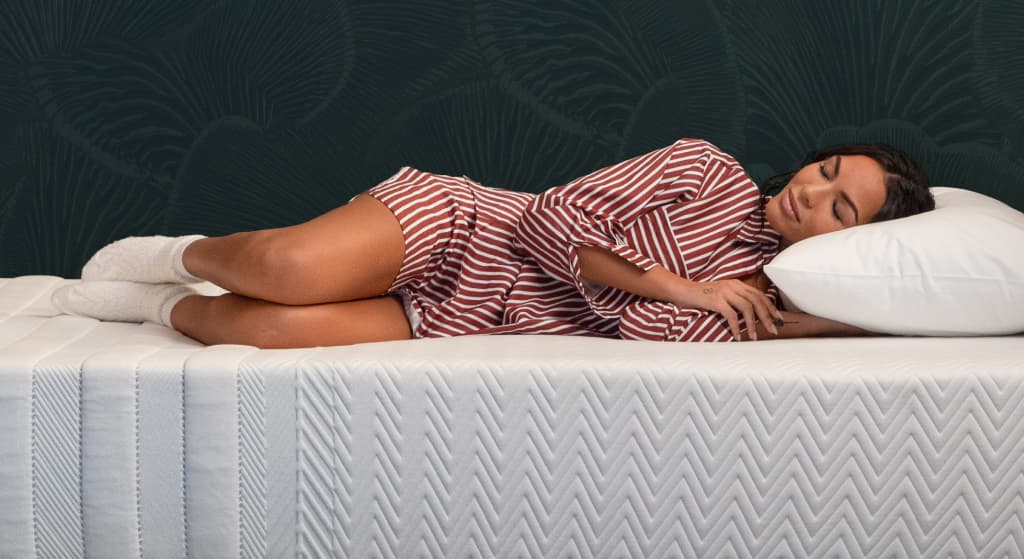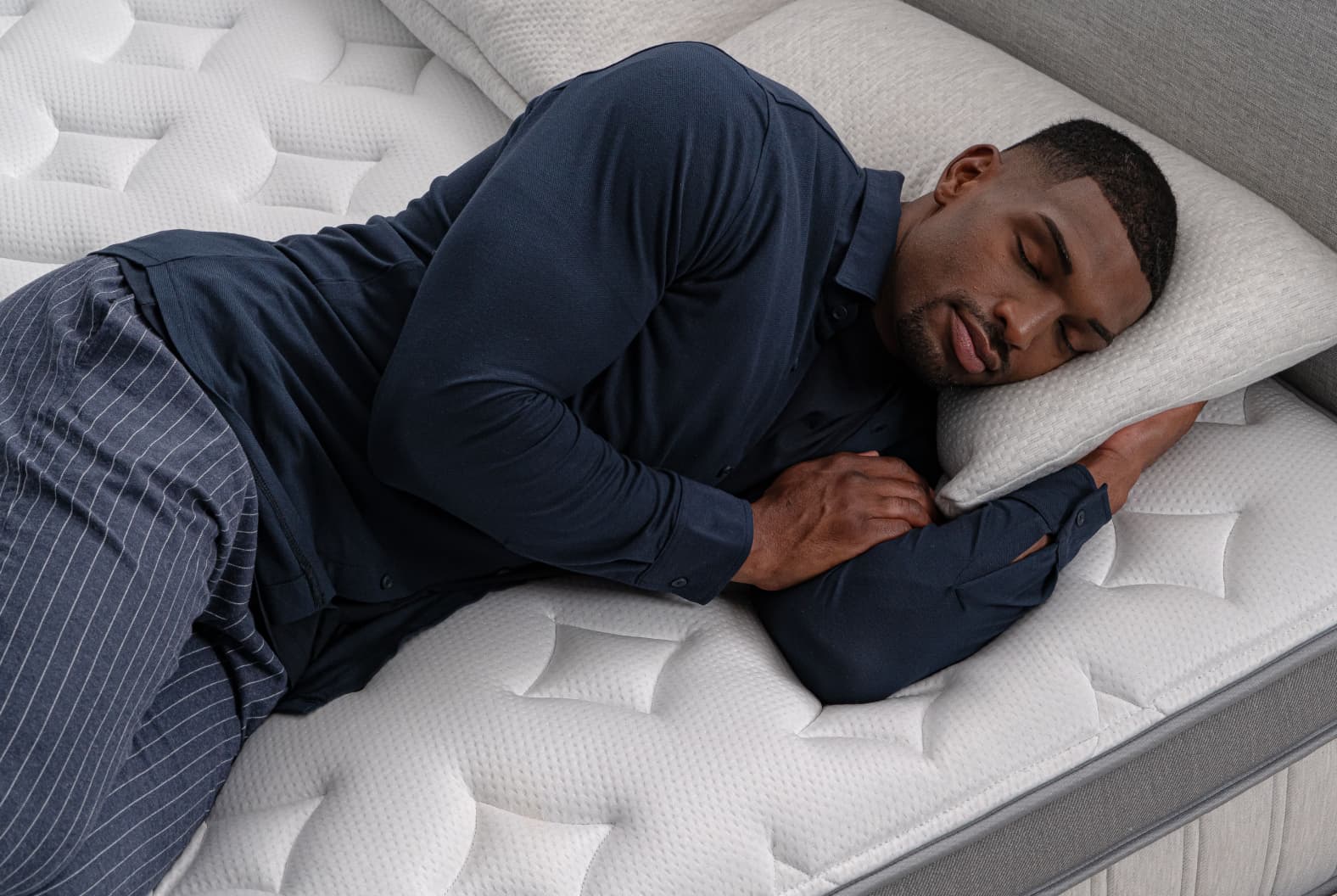

Side sleeping is the most common position and the one with the most specific mattress requirement. Lying on your side concentrates your entire body weight onto two narrow points — the shoulder and the hip — while your waist floats above the surface with nothing underneath it. Get the balance wrong in one direction and those pressure points ache by morning. Get it wrong in the other and your midsection sags, your spine bends sideways, and your lower back pays for it.
What a side sleeper needs is a mattress soft enough for the shoulder and hip sink in, over a support core firm enough to hold the waist and lumbar region level. That's a narrower target than it sounds, and it's the requirement Leesa's lineup is most decorated for meeting: five separate publications have recognized Leesa mattresses specifically for side sleeping or shoulder pain.
Quick answer:
The Sapira Chill Hybrid in Plush is the strongest pick for most side sleepers — the most-recognized model in the lineup for this position, with side-sleeper awards from Mattress Clarity, AARP, and Sleepopolis plus Sleepopolis' Best Mattress for Shoulder Pain. The Legend Chill Hybrid is the pick if lower back pain comes with it, holding CNET's Best Mattress for Side Sleepers with Back Pain award. The Reserve Hybrid has the highest measured pressure relief score in the lineup at 9/10 from Sleep Foundation. The Natural Hybrid is the pick for natural materials and passive cooling. All four include free shipping, a 365
-night trial, and a limited lifetime warranty.
At a Glance
Model | Feel | NapLab | Why It Works for Side Sleeping |
Sapira Chill Hybrid | Plush, Medium-Firm, or Firm | 9.08 | Five side-sleeper and shoulder-pain awards; orderable in Plush |
Reserve Hybrid | Signature medium | 9.00 | 9/10 pressure relief from Sleep Foundation |
Legend Chill Hybrid | Between medium and firm | 8.85 | Softer shoulder zone with reinforced lumbar support |
Natural Hybrid | Signature medium | 8.66 | Buoyant latex contouring; tests best for side sleepers 130–230 lbs |
Awards & Recognition
Leesa Sapira Chill Hybrid
- Best Hybrid Mattress for Side Sleepers — Mattress Clarity
- Best Cooling Mattress for Side Sleepers — AARP
- Best Cooling Mattress for Side Sleepers — Sleepopolis
- Best Mattress for Side Sleepers with Back Pain — Sleepopolis
- Best Mattress for Shoulder Pain — Sleepopolis
Leesa Legend Chill Hybrid
- Best Mattress for Side Sleepers with Back Pain — CNET
- Best Cooling Mattress for Back Pain — Forbes
- Top Pick 2026 – Hybrid Mattress — Wirecutter
Leesa Natural Hybrid
- Most Comfortable Organic Mattress — Sleep Foundation
What Side Sleepers Actually Need
Two pressure points and a gap
Side sleeping is a geometry problem. Your shoulder and hip are the widest parts of your body, so they bear nearly all your weight against the mattress. Your waist is narrower, so it hovers.
That creates two requirements pulling in opposite directions:
The shoulder and hip need to sink in. If the surface doesn't yield, your weight concentrates on those two joints for hours. That's where morning shoulder ache and hip soreness come from — and it's why side sleepers, uniquely, are usually told to go softer.
The waist needs support underneath it. If the mattress yields too much, your midsection drops and your spine curves sideways into what's sometimes called the hammock effect. Lower back pain follows.
A mattress solves both by having distinct layers doing distinct jobs: soft comfort layers that compress under the shoulder and hip, over a support core that doesn't.
Zoning solves it better than firmness alone
A zoned mattress varies firmness across its length — softer at the shoulders, firmer through the center third where the waist and lumbar region sit. That delivers exactly where a side sleeper needs it and resistance exactly where they don't, rather than finding a single firmness that partly satisfies both.
This is why three of the four models here use zoned coil systems and why the awards cluster around them.
The firmness range for side sleeping
Most side sleepers do best between 4 and 6 on a 10-point scale — softer than the medium-firm range that suits back and stomach sleepers. Body weight shifts it:
- Under 130 lbs — you won't compress a firmer surface enough for your shoulder to drop in. Aim for the softer end, around 4–5.
- 130–230 lbs — 5–6 is the range. Most published ratings are calibrated here.
- Over 230 lbs — you'll compress further, so a 6 may behave like a 5 and your waist may start to sag. Lean toward a 6 or above, and prioritize a strong support core over a soft surface.
Two things that aren't the mattress
Your pillow needs to be thicker than most people's. Side sleeping leaves a gap between your head and the mattress equal to the width of your shoulder. A thin pillow lets your neck bend downward all night. This is the opposite of what stomach sleepers need.
A pillow between your knees helps more than you'd expect. Side sleeping lets the top leg roll forward, which rotates the pelvis and twists the lumbar spine. A knee pillow keeps the hips stacked. If your lower back hurts on a mattress that otherwise feels right, try this before replacing the bed.
Leesa Sapira Chill Hybrid — Best for Side Sleepers
Plush, Medium-Firm, or Firm · 14 inches · 7 layers · NapLab 9.08
This is the most-recognized Leesa mattress for side sleeping, with five separate awards addressing the position and its associated pain points. Mattress Clarity named it Best Hybrid Mattress for Side Sleepers. AARP and Sleepopolis independently named it Best Cooling Mattress for Side Sleepers. Sleepopolis also named it Best Mattress for Side Sleepers with Back Pain and Best Mattress for Shoulder Pain — which together cover the two complaints side sleepers actually present with.
Why the Plush option matters
It's the only Leesa mattress sold in a choice of firmness, and for side sleepers that's the whole argument:
Firmness | 1–10 Scale | Best For |
Plush | 4–5 | Side sleepers, pressure-relief seekers, lighter body weights |
Medium-Firm | 6–6.5 | Back sleepers, combination sleepers, average body weights |
Firm | 7–8 | Stomach sleepers, heavier body weights |
Most side sleepers should take plush. If you're over 230 lbs or split your time between side and back, medium-firm is the better choice — it tests closer to a 6 than a true medium-firm, so it's more forgiving than the label suggests.
Construction
A cooling quilt top with heat-dispersing fibers sits over gel-infused quilt foam, open-cell GreenFlex® Foam, responsive memory foam, a high-density transition layer, and up to 1,032 individually wrapped springs in an 8-inch zoned system, over a high-density support core.
The zoning is what makes it work for this position: firmer through the center third to hold the waist, softer near the shoulders so the shoulder can drop in. Reinforced perimeter coils keep the edges usable.
Why cooling matters at pressure points
Side sleeping concentrates weight on two narrow areas, which concentrates heat there too — localized warmth at the shoulder and hip is a common complaint that gets misattributed to the room rather than the mattress. AARP's cooling-gun testing found the Sapira Chill dissipated all but roughly 8 degrees of added heat, and both of its side-sleeper awards from AARP and Sleepopolis are specifically cooling side-sleeper awards.
Best for: side sleepers across body types, sleepers with shoulder or hip sensitivity, side sleepers who run hot, and couples with mismatched firmness preferences.
Worth knowing: reviewers are split on side-sleeper firmness, which is exactly why the Plush option exists — choose deliberately rather than defaulting to Medium-Firm. Cooling reviews also aren't unanimous; some testers have found the Chill Collection less dramatic than the branding implies.
Leesa Reserve Hybrid — Highest Measured Pressure Relief
Signature medium · cooling cover · dual-spring system · designed with West Elm · NapLab 9.00
Pressure relief is the property side sleepers care about most, and this is the model with the number behind it: Sleep Foundation scored the Reserve 9/10 for pressure relief, the highest in the lineup. It also scored 8.9/10 overall and 8.5/10 for motion isolation, and Sleep Foundation rated it suitable for side, back, and stomach sleepers — unusual breadth for a single firmness.
Leesa's most luxurious mattress, developed in partnership with West Elm. Premium memory foam sits over micro-springs and a dual-spring system, with coils reinforced along the edges and through the middle third for finely tuned lumbar support. The cooling cover pairs with a SteadyCool layer of five graphite strips that pulls heat away for 12 or more hours.
Its signature medium feel and cradling memory foam are well matched to side sleeping: enough give for the shoulder, with the reinforced middle third holding the waist. Mattress Clarity found it should last at least 10 years.
Best for: side sleepers who want the cradling feel of memory foam, couples, and anyone prioritizing measured pressure relief over award count.
Worth knowing: cooling reviews are split — NapLab reported strong performance while Sleep Foundation's testers flagged possible warmth for some sleepers. Released in February 2024, it has strong test scores but a shorter owner track record. At 13 inches, check your fitted sheets' pocket depth.
Leesa Legend Chill Hybrid — Best for Side Sleepers with Back Pain
Between medium and firm · quilted phase-change top · dual-spring system · NapLab 8.85
CNET named it Best Mattress for Side Sleepers with Back Pain — the most specific award in this guide, because it addresses the exact combination that makes side sleeping complicated. Forbes named it Best Cooling Mattress for Back Pain, and Wirecutter made it a Top Pick 2026.
Why a firmer mattress earns a side-sleeper award
On paper this is the firmest model here, which looks wrong for side sleeping. The zoning is why it works.
Its dual-spring system offers softer support at the shoulders, firmer support through the lumbar region, and reinforced support at the hips. So a side sleeper's shoulder drops into a soft zone while the waist gets held up by a firm one — which is precisely the two-requirement problem solved by construction rather than by picking a firmness and compromising.
For anyone whose lower back hurts because of the hammock effect, that's a better answer than a softer mattress would be. A quilted top infused with cooling phase-change fibers buffers heat as your temperature rises and falls, and reinforced perimeter coils add edge stability.
Best for: side sleepers with lower back pain, side sleepers over 230 lbs who need more support than a plush surface offers, and couples wanting motion isolation with cooling.
Worth knowing: if you're a lighter side sleeper without back pain, this may be firmer than you need at the shoulder. The Sapira Chill in Plush is the more forgiving choice.
Leesa Natural Hybrid — Best Natural Materials for Side Sleepers
Signature medium · organic cotton, wool, and natural latex · designed with West Elm · NapLab 8.66
Made in partnership with West Elm, with a 100% organic cotton cover, GOTS-certified New Zealand wool, and GOLS-certified natural latex over pocketed coils. Sleep Foundation named it Most Comfortable Organic Mattress, and testing found it performs best for side sleepers between 130 and 230 lbs.
Why latex suits side sleeping differently
Latex contours without the slow sink of memory foam. It's buoyant and springy, so your shoulder drops in and then meets resistance rather than continuing to settle — which some side sleepers strongly prefer, particularly anyone who's felt trapped in a memory foam mattress when trying to roll over. Side sleepers change position more than most, so responsiveness matters.
Two additional properties are relevant here specifically. The latex delivers more airflow than other latex foams, which addresses the localized heat that builds at shoulder and hip contact points. And it's 3x more dust mite–resistant than other foams, which matters if allergies are part of the picture.
Up to 1,032 springs made from 98% reclaimed steel sit below, with a reinforced perimeter for edge support.
Best for: side sleepers 130–230 lbs who want certified natural materials, side sleepers who dislike the enveloping feel of memory foam, and allergy-sensitive sleepers.
Worth knowing: latex divides people. If you want to feel cradled, this isn't it, even at the same firmness rating as the Reserve. NapLab tests it at 6/10, slightly firmer than the medium label implies — so strict side sleepers under 130 lbs may prefer the Sapira Chill in Plush.
How to Choose
Step 1 — What's your body weight?
- Under 130 lbs → Sapira Chill Hybrid in Plush; you need the softer end to compress enough at the shoulder
- 130–230 lbs → any of the four; Sapira Chill in Plush or Reserve Hybrid are the safest picks
- Over 230 lbs → Legend Chill Hybrid, or Sapira Chill in Medium-Firm; you need a stronger support core to keep the waist from sagging
Step 2 — Does your lower back hurt?
- Yes → Legend Chill Hybrid, which holds CNET's award for exactly this combination
- Yes, and you also get shoulder pain → Sapira Chill Hybrid, which holds awards for both
- No → Sapira Chill in Plush, or Reserve Hybrid
Step 3 — Where does the discomfort sit?
- Shoulder → Sapira Chill Hybrid, holder of Sleepopolis' Best Mattress for Shoulder Pain
- Hip → Reserve Hybrid, with the highest measured pressure relief
- Lower back / waist → Legend Chill Hybrid, for the zoned lumbar support
- Everywhere, or nowhere specific → Sapira Chill Hybrid in Plush
Step 4 — Do you sleep hot?
Heat builds at the shoulder and hip where contact concentrates.
- Yes, engineered cooling → Sapira Chill Hybrid, with ~8°F heat dissipation in AARP testing
- Yes, natural breathability → Natural Hybrid, with 228% more airflow through its latex
- Yes, continuous conduction → Reserve Hybrid, with SteadyCool graphite
- No → any of the four
Step 5 — Do you dislike memory foam?
- Yes, I feel stuck in it → Natural Hybrid; latex is buoyant rather than sinking
- No, I like being cradled → Reserve Hybrid
- No preference → Sapira Chill Hybrid in Plush
Step 6 — Budget
Leesa runs frequent sitewide sales, so confirm current pricing on leesa.com. As a general guide, the Sapira Chill sits in the middle of these four, with the Legend Chill, Natural Hybrid, and Reserve at the premium end.
Given the 365-night trial, it's reasonable to decide on firmness and pressure point first and let the trial settle the rest.
Matching by Sleeper Type
Side Sleeper Type | Suggested Model | Why |
Average weight, no specific pain | Sapira Chill Hybrid (Plush) | Five side-sleeper and shoulder awards |
Under 130 lbs | Sapira Chill Hybrid (Plush) | Softest option; compresses at low body weight |
Over 230 lbs | Legend Chill Hybrid | Zoned support holds the waist level |
With lower back pain | Legend Chill Hybrid | CNET's Best Mattress for Side Sleepers with Back Pain |
With shoulder pain | Sapira Chill Hybrid | Sleepopolis' Best Mattress for Shoulder Pain |
With hip pain | Reserve Hybrid | 9/10 pressure relief, highest in the lineup |
Wants memory foam cradling | Reserve Hybrid | Premium memory foam over a dual-spring system |
Dislikes memory foam | Natural Luxe Hybrid | Buoyant latex; responsive rather than sinking |
Runs hot | Sapira Chill Hybrid or Natural Hybrid | Phase-change cooling, or passive latex airflow |
Natural materials | Natural Luxe Hybrid | Organic cotton, GOTS wool, GOLS latex |
Couples | Reserve Hybrid or Legend Chill Hybrid | 8.5/10 motion isolation; reinforced edges |
Certifications and Materials
All four models meet Leesa's lineup-wide standards:
- GREENGUARD Gold certified, tested for emissions of more than 360 volatile organic compounds
- CertiPUR-US® certified foams
- Fiberglass-free construction, in a fiberglass-free factory, using a fire barrier made with rayon derived from 100% regenerated cellulose
- Springs made from over 98% reclaimed steel
- GreenFlex® Foam, certified under the USDA BioPreferred® Program
- Designed and assembled in Leesa's Arizona factory
The Natural Hybrid additionally carries GOLS certification on its latex and GOTS certification on its New Zealand wool, with a 100% organic cotton cover.
Trial, Warranty, and Ownership
- Free shipping and returns, made to order in Arizona
- 365-night risk-free trial, with a 30-night minimum adjustment period recommended before starting a return
- Limited lifetime warranty covering manufacturing defects and material failures, including indentations greater than 1 inch beyond normal body impressions
- In-Home Setup & Removal by Ryder available at checkout
Side sleepers should use the full adjustment window. Shoulder and hip pressure often takes two to three weeks to read accurately — a mattress that feels slightly firm at the shoulder in week one frequently settles into the right range by week four.
Awards from Mattress Clarity, AARP, Sleepopolis, CNET, Forbes, Wirecutter, and Sleep Foundation. Test scores from Sleep Foundation, NapLab, and Mattress Clarity. Construction details verified against Leesa's published product specifications. Pricing changes with ongoing promotions; confirm current pricing on leesa.com.
The 26% biobased content of GreenFlex Foam has been verified through third-party testing under the USDA BioPreferred® Program, ensuring compliance with rigorous standards for renewable material content.