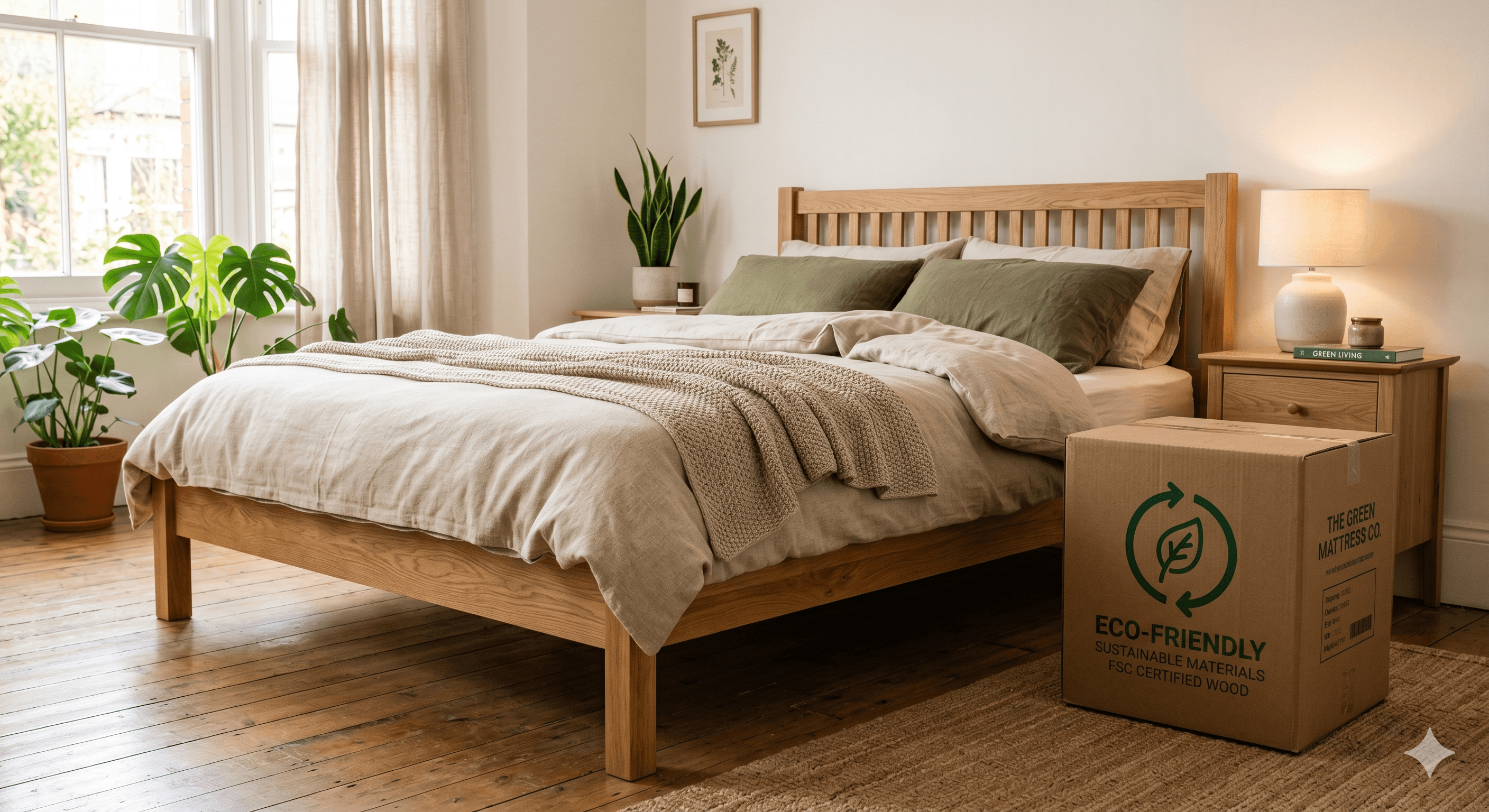

Eco-friendly is one of the biggest buzzwords of the 21st century. From “eco-friendly” socks to “green” motorbikes, anything can be “good” for the environment. Even “green mattresses” have hit the market, and people are curious about what a green bed actually is.
Could an eco-sleep station rock your world, or is it just another marketing scheme? Learn what eco-friendly mattresses actually are, why many soy-based foams don’t quite measure up, and the new standards in environmentally-friendly mattresses available now.
What makes a mattress eco-friendly? (and what doesn’t count)
There are really only three main factors that make a mattress eco-friendly. They are:
Lack of Harmful Chemicals: Some conventional mattress brands rely on chemical-heavy manufacturing processes that can keep off-gassing* long after your mattress moves in.
Engineered Using Responsible Practices: The production method is designed to reduce the mattress company’s carbon footprint**.
Made With Sustainable Materials: These mattress materials are renewable, which means they naturally and quickly replace themselves. They also naturally decompose and have a minimal negative impact on the world.
*Off-gassing is exactly what it sounds like. It occurs when chemicals are released from new materials. In many cases, mattress off-gassing is harmless and usually just smells a little weird for a short time.
Sometimes, these chemicals are actually VOCs (volatile organic compounds) and may potentially cause asthma symptoms and respiratory irritation. That’s why it’s so important to buy an eco-friendly mattress or a mattress designed by an eco-conscious company.
**A mattress company’s carbon footprint is the total greenhouse gas emissions created to make, move, and deliver its mattresses. This includes:
Sourcing raw materials
Manufacturing
Packaging
Shipping
It’s the environmental tab left behind every time a mattress goes from factory floor to bedroom door. Brands that use smarter materials and more efficient production can help keep that footprint lighter.
Recognizing eco-friendly products can still be tough. Green colored marketing? It can signal a green company, but it doesn’t automatically mean eco-friendly. Does the company market its sustainable materials but stay silent when asked about sustainable production? Probably not that eco-friendly.
The best and fastest way to determine whether a mattress is eco-friendly is to check its certifications.
The certifications that actually matter
These are the three certifications that tend to pop up the most: CertiPUR-US, USDA Biobased, and GREENGUARD Gold. Here’s what you need to know.
USDA Certified Biobased Product
Think of this certification as the USDA’s way of separating real renewable content from wishful thinking. The USDA Certified Biobased Product label means a product has been independently tested to verify that it contains a stated amount of renewable biological ingredients derived from plants or other renewable resources, rather than relying entirely on petroleum-based inputs (i.e., derived from crude oil...gross).
For example, Leesa is introducing GreenFlex® BioFoam, a USDA-certified biobased product with 26% renewable biological content. This means it's not just green-sounding language on a label, but third-party verified material.
CertiPUR-US® Certified Foam
Foam can be mysterious. It may be comfortable, but at what cost? That is where CertiPUR-US® certified foam comes in.
This independent certification means the foam has been tested against standards for content, emissions, and durability. Certified foams are made without:
Ozone-depleting substances
Formaldehyde
Certain phthalates are regulated by the U.S. Consumer Product Safety Commission
Heavy metals, such as mercury and lead
They also meet low-VOC indoor air quality standards. In short, a CertiPUR-US® Certified Foam mattress has passed a background check.
GREENGUARD Gold Certified Mattress
The mattress lives in the bedroom, where people spend nearly a third of their lives, so indoor air quality matters. GREENGUARD Gold-certified mattresses are tested for low chemical emissions, including more stringent limits designed for sensitive environments.
That means the product has met rigorous standards for VOC emissions and helps improve indoor air quality. GREENGUARD Gold is especially valued in homes, nurseries, schools, and other spaces where people want to breathe a little easier. Because your mattress should help you rest at night, not keep you up hacking and struggling to breathe.
What is plant-based foam, exactly?
Plant-based foam is the sustainable material that the best green mattresses are made with. It’s essentially foam made with a portion of its ingredients sourced from renewable biological materials, rather than relying entirely on petroleum-based inputs. In mattress construction, this usually means that certain raw materials used to make polyurethane foam are partially replaced with plant-derived ingredients, such as soy or castor oil.
Think of it less as “a mattress made of plants” and more as a smarter update to traditional foam chemistry. That distinction matters because not all plant-based foams are created equal. Some only use a teeny-tiny percentage of renewable content, so while “plant-based” sounds simple, the real story lies in sourcing, formulation, and performance.
How polyols work (and why it matters where they come from)
Most plant-based foam is made with polyols, so it’s important to understand what this material is. Polyols are one of the key building blocks used to make polyurethane foam, the cushioning material found in many mattresses.
In simple terms, they help determine how a foam feels and performs. This includes its:
Softness
Resilience
Pressure relief
Long-term durability
Change the polyol, and you can change the foam itself. A poor-performing polyol makes your mattress feel more like a hard rock than a proper bed. A poorly sourced polyol spells bad news for the environment.
Traditionally, many polyols have been petroleum-derived. Plant-based foam (also called bio foam) uses alternative polyols sourced from renewable materials like agricultural feedstocks. That can help reduce reliance on fossil-based inputs, but where those materials come from matters just as much as the chemistry itself.
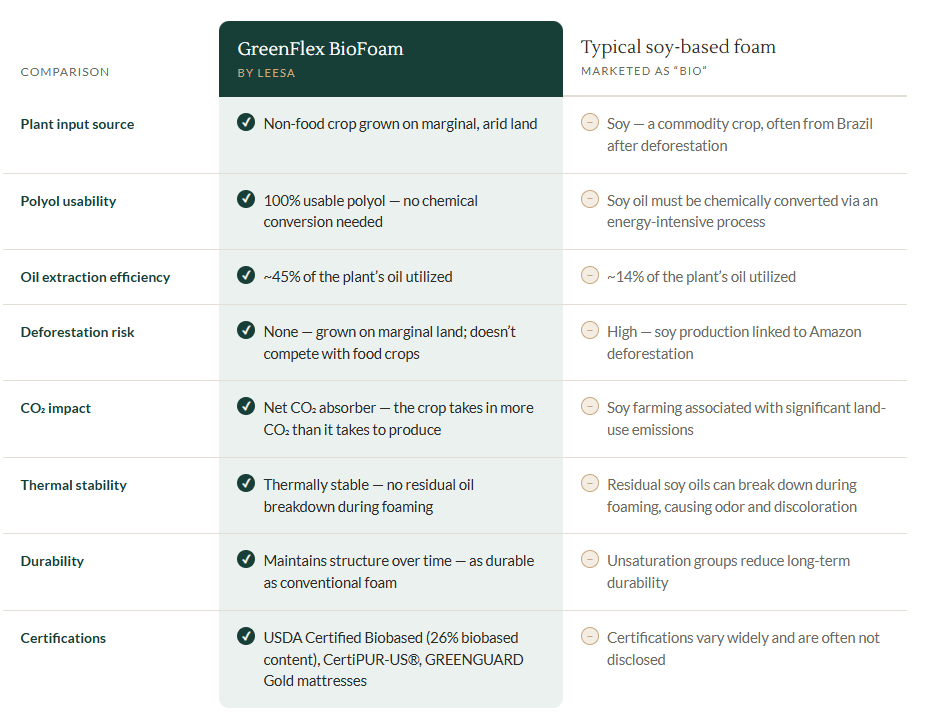
Leesa’s GreenFlex uses plant-based materials sourced from non-food crops grown on marginal, arid land. In other words, inputs chosen not to compete with food agriculture or drive deforestation. That is a more thoughtful way to build better foam from the ground up.
Get it? Ground up, because Leesa’s polyols come from renewable plants. Even Leesa puns are eco-friendly.
The problem with most “bio” foams
The term “bio foam” sounds promising, and sometimes it is. But in the mattress world, it can also be frustratingly vague. As mentioned, many foams marketed as bio-based or plant-based still rely heavily on conventional petroleum inputs, with only a partial amount of renewable content added to the formula.
That does not make them bad products. It just means shoppers deserve more clarity than a leafy icon on a product page.
In many cases, brands do not disclose:
How much renewable content is actually included
What plant source is used
Whether the material is third-party certified
How the foam performs over time
Whether sourcing introduces other environmental tradeoffs
This is where buyers are reasonably worried about greenwashing. A foam can technically contain plant-derived ingredients while still depending on 99% of its ingredients from commodity crop systems.
The question isn’t “Is it bio foam?” It’s “How bio-based is the foam? What is it sourced from? Who is it certified by? Does it still perform beautifully?”
We know that's a lot to consider, so look for mattress brands that make this information simple and easy to find. You shouldn’t have to go on a scavenger hunt to identify whether a company uses good bio foam or not.
Why soy-based foams fall short
Many bio foams are made using soy. It’s cheap and plentiful, making it an attractive polyol option. Unfortunately, these soy polyols aren’t the best option.
A more thoughtful approach: Leesa’s GreenFlex BioFoam
Not all plant foams are created with the same level of intention. Some simply swap in a renewable ingredient, pop some green lettering on their ads, and call it a day.
The mattress may seem eco-friendly, but in reality, it’s a non-organic mattress with little environmental impact. Leesa took a more considered approach with GreenFlex® BioFoam.
As mentioned, Leesa’s GreenFlex BioFoam is a USDA Certified Biobased Product with 26% verified renewable biological content, and has CertiPUR-US® certified foam and a big, spanking GREENGUARD Gold certified mattress sticker.
It was also developed in-house to help streamline production and reduce transport-related emissions. That is the difference between a trendy label and a transparent material story.
How GreenFlex performs for sleepers
Sustainability matters, but no mattress earns a place in your bedroom unless it also sleeps beautifully. GreenFlex delivers the signature Leesa feel. It’s comfortable, responsive, and built to last, while taking a kinder approach to the planet.
Open-Cell Design Promotes Airflow: Breathable structure helps move heat away from the body for a cooler, more comfortable night’s sleep.
Pressure-Relieving Comfort: Cushions common pressure points like shoulders, hips, and lower back to help reduce tossing and turning.
Responsive Feel: Light, adaptive foam quickly adjusts as you move, making it easier to change positions without feeling stuck.
Long-Lasting Durability: Built to hold its shape and supportive feel over time, helping extend mattress life and reduce premature replacement.
How to evaluate any eco mattress claim
You now know how to identify companies that are actually using eco-friendly practices and ingredients. It’s also important to look for mattresses that use one or more of the following organic materials.
GOTS-certified Organic Wool: A quilted plush topper made with GOTS-certified New Zealand wool and wrapped in organic cotton creates a breathable, cool, and cozy feel.
Organic Cotton Cover: Made with 100% organically grown cotton fiber. Uses less water than conventional cotton, avoids harmful pesticides and insecticides, and makes up 84.5% of the Legend cover.
GOLS-Certified Natural Latex: Meets high standards for organic purity and is internationally certified as low-emission latex with no VOCs or organic pollutants.
Materials like certified organic latex and breathable organic cotton cover contribute to an entire mattress composition that’s environmentally healthy. These mattresses are also good for you and your home.
They lower household irritants, which provides needed relief for those with allergies or other sensitivities. All the better for sensitive kiddos or those living with severe seasonal allergies.
Before you check the box on a new mattress company, make sure they’re dedicated to low-impact manufacturing and shipping and that they’re fiberglass free. Leesa groups shipments, prioritizes sea freight, and sources 80% of materials domestically.
Leesa mattresses also contain no fiberglass and are made in a fiberglass-free factory. Instead, they use fire-retardant yarn with a rayon barrier made from regenerated cellulose for a safer, cleaner approach.
The bottom line: what to look for in a truly eco mattress
A truly eco-friendly mattress should offer more than leafy logos and vague promises. It should be backed by real certifications, thoughtful materials, cleaner manufacturing, and the kind of transparency that does not require detective work. Look for verified standards like CertiPUR-US®, USDA Certified Biobased, and GREENGUARD Gold. Be on the lookout for materials chosen for both comfort and environmental impact.
That is where Leesa stands apart from the rest. From GreenFlex® BioFoam with verified renewable content to responsibly sourced components and reduced shipping emissions, Leesa proves that sustainability and sleep quality can share the same bed. The best eco mattress should help you rest easier in every sense of the phrase.