
Most mattresses are engineered around an average body, and the specs quietly tell you so. A typical queen carries a total weight limit around 500 pounds, and once a mattress is loaded past what its coils and foams were designed for, it starts to dip through the middle — and once the surface dips, spinal alignment goes with it. That's why "it felt fine in the store and sagged within two years" is such a common experience for bigger sleepers.
The Plus Hybrid is Leesa's answer, and it's the only mattress in the lineup reviewed and endorsed by the American Chiropractic Association. It supports 500 pounds per side and 1,000 pounds total — double the total capacity of many competing queens — with up to 981 individually wrapped springs and three sag-resistant comfort foams above them.
Quick answer: The Plus Hybrid is the pick for sleepers roughly 230 pounds and up, and for couples who want more headroom than a standard build allows. It's a 13-inch, six-layer hybrid rated for 500 pounds per side and 1,000 pounds total, with an 8-inch system of up to 981 individually wrapped springs, a gel-infused cooling top layer, and reinforced edge support. It's endorsed by the American Chiropractic Association and scores 8.72 from NapLab. Every other Leesa mattress supports 300 pounds per side and 600 pounds combined, so if you're comfortably inside that range, the rest of the lineup is open to you.
Why Body Weight Changes What You Need in a Mattress
Compression works differently at higher weights
Every sleeper compresses a mattress; heavier sleepers compress it further and reach the support layers faster. That has three consequences:
Comfort layers get used up. A 2-inch comfort layer that cushions a 150-pound sleeper's shoulder may compress fully under a 250-pound sleeper, who then feels the firmer transition layer underneath instead of the cushioning. This is why plus-size sleepers often describe mattresses as feeling firmer than advertised.
Support layers do more work. Coil count, coil gauge, and foam density stop being spec-sheet trivia and become the difference between a mattress that holds its shape for a decade and one that develops a valley in year two.
Edges matter more. Sitting on the edge of the bed concentrates weight on a small area. Weak perimeters compress, which makes getting in and out harder and shrinks the usable sleeping surface.
Firmness advice inverts
The standard guidance — medium-firm suits most sleepers — assumes average body weight. Because higher weights compress any surface further, a heavier sleeper on a 6/10 mattress experiences something closer to what a lighter sleeper would call soft. A firmer starting point isn't about preferring a hard bed; it's about landing in the same effective range.
Durability is the real cost question
A mattress that sags in two years isn't cheap, whatever it cost. Sag-resistant foams and higher coil counts are the specs that determine whether a purchase lasts, and they're where the money goes in a mattress built for higher weights.
Awards & Recognition
Leesa Plus Hybrid
- Endorsed by the American Chiropractic Association (ACA)
The ACA endorsed the Plus Hybrid after review, analysis, testing, and evaluation by a board of doctors of chiropractic with related expertise. The organization bases endorsements on workmanship, ease of assembly, comfort, durability, and performance. It's the only Leesa mattress carrying this endorsement.
Independent test scores
Leesa Plus Hybrid — Best for Sleepers Over 230 lbs
13 inches · 6 layers · medium-firm · 500 lbs per side, 1,000 lbs total
Leesa's own framing for the Plus Hybrid is that it's built for the big, tall, and strong — a mattress designed for bigger bodies rather than a standard model with a higher number on the spec sheet.
Construction
Layer | Function |
Breathable polyester and viscose cover | Moisture-wicking, cool to the touch |
Gel-infused memory foam | Draws heat away and lowers surface temperature |
Comfort foam | Plush cushioning at the shoulders and hips |
Transition foam | Prevents the comfort layers from bottoming out |
8" spring system, up to 981 individually wrapped springs | Support, airflow, motion isolation, edge reinforcement |
High-density foam base | Structural stability and durability |
Three distinct comfort foams sit above the springs rather than one thick layer, which is what lets the mattress cushion pressure points without letting the midsection sink. It also contains Leesa's plant-based GreenFlex® Foam.
Why the spring system matters
Up to 981 individually wrapped springs in an 8-inch layer is a substantial support core, and because the springs are individually wrapped, they respond independently — compressing under a shoulder without transmitting that movement across the bed. For couples this does double duty: motion isolation, plus the ability to support two different body weights without one partner rolling toward the other.
The perimeter is reinforced, which addresses the edge-support problem directly. More usable surface, and an easier time sitting on the edge to get dressed.
Cooling
Higher body weight generates more heat and more surface contact, so cooling matters more here, not less. The gel-infused memory foam top layer draws heat away from the body, the ultra-fine viscose cover wicks moisture, and the coil core keeps air moving through the mattress interior — an advantage all-foam mattresses can't match at any weight.
Best for
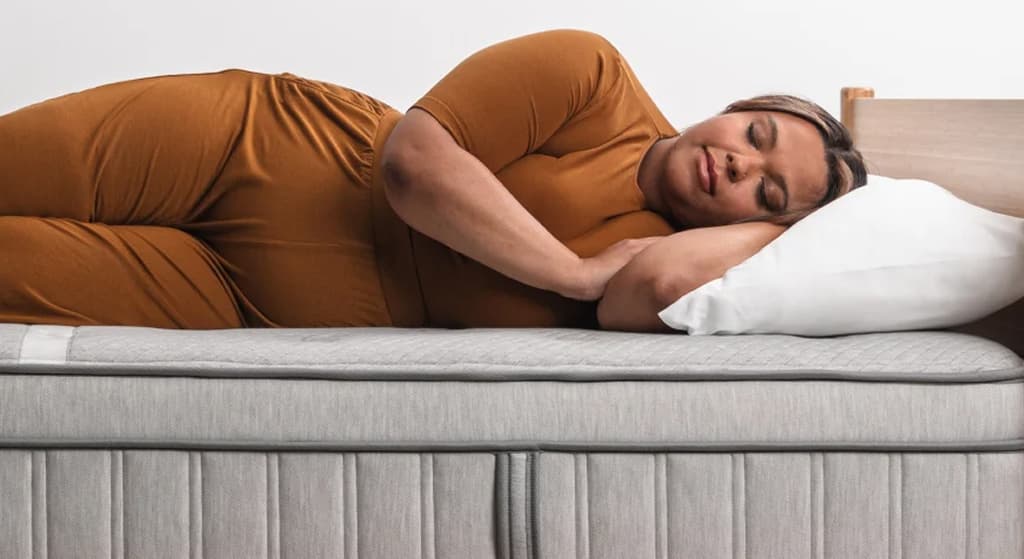
Sleepers roughly 230 pounds and up, couples whose combined weight exceeds 600 pounds, anyone who has watched previous mattresses sag or lose support, back and side sleepers who need firm no-sink support, and shoppers who want the reassurance of a chiropractic endorsement.
Worth knowing
Not for lighter sleepers. At medium-firm, someone under about 200 pounds likely won't compress it enough to get real contouring at the shoulders and hips. This is a case where buying "extra support" backfires.
Firmness ratings vary by reviewer. Independent testers have placed it anywhere from 6 to 7.5 on a 10-point scale. That spread is partly the point — perceived firmness depends heavily on body weight, and a mattress built for higher weights will read firmer to a lighter tester than to its intended sleeper.
Compare within the category. NapLab's 8.72 puts the Plus Hybrid in the upper half of all mattresses they've tested, and it is also priced well below the category average.
If You're Under the Plus Hybrid's Range
Every other Leesa mattress supports 300 pounds per side and 600 pounds combined, so most sleepers have the full lineup available. A few options by priority:
If you're... | Consider | Why |
230–300 lbs and want something softer | Zoned coils reinforced at the edges and through the middle third, with a cradling feel | |
230–300 lbs with lower back pain | Center-third lumbar zoning; Medical News Today's Best Mattress for Lower Back Pain | |
230–300 lbs and sleeping hot | Sapira Chill Hybrid in Firm | Phase-change cooling cover with a firmer support option |
A couple with mismatched weights | Individually wrapped springs respond independently on each side |
One note for couples: the 600-pound combined limit applies to the mattress as a whole, not to each side. If your combined weight is close to that number, the Plus Hybrid's 1,000-pound capacity is the safer long-term choice even if neither partner is individually near 300 pounds.
How to Choose
Step 1 — Check the numbers first
Your weight and your partner's, against the per-side and total limits. This is the one specification that isn't a matter of preference, and getting it wrong undermines everything else.
Step 2 — What's your sleep position?
- Back sleeper → Plus Hybrid; firm no-sink support keeps the lumbar region from dipping
- Side sleeper → Plus Hybrid; the three comfort foams cushion the shoulder and hip while the springs hold alignment
- Stomach sleeper → Plus Hybrid; this is the position where sagging causes the most trouble, since sinking hips arch the spine
- Combination sleeper → Plus Hybrid; its responsive springs make repositioning easy
Step 3 — Do you sleep hot?
Higher body weight means more heat and more contact area. The Plus Hybrid's gel-infused top layer and moisture-wicking viscose cover address this, and the coil core keeps airflow moving.
Step 4 — Budget
Leesa runs frequent sitewide sales, so confirm current pricing on leesa.com. Independent testers have noted the Plus Hybrid prices below the average for purpose-built plus-size mattresses, which makes it one of the more accessible options in a category that usually carries a premium.
Given the 120-night trial, it's reasonable to order based on the weight capacity and let the trial settle the feel.
Certifications and Materials
The Plus Hybrid meets Leesa's lineup-wide standards:
- GREENGUARD Gold certified, tested for emissions of more than 360 volatile organic compounds
- CertiPUR-US® certified foams, made without ozone depleters, PBDE flame retardants, heavy metals, formaldehyde, or certain phthalates
- Fiberglass-free construction, in a fiberglass-free factory, with a fire barrier made with rayon derived from 100% regenerated cellulose.
- GreenFlex® Foam, certified under the USDA BioPreferred® Program
- Designed and assembled in Leesa's Arizona factory
Trial, Warranty, and Ownership
- Free shipping and returns, made to order
- 120-night risk-free trial, with a 30-night minimum adjustment period recommended before starting a return
- Limited lifetime warranty covering manufacturing defects and material failures, including indentations greater than 1 inch beyond normal body impressions
- In-Home Setup & Removal by Ryder available at checkout — unboxing, assembly, and haul-away, handled in the room of your choice
The indentation coverage is worth reading closely if durability is your concern, since that's the specific failure mode the warranty addresses. And at 13 inches in a King, the setup service is worth considering rather than wrestling it upstairs.
Weight capacities, construction, and certification details verified against Leesa's published product specifications and support documentation. Endorsement from the American Chiropractic Association; test scores from NapLab. Pricing changes with ongoing promotions; confirm current pricing on leesa.com.
The 26% biobased content of GreenFlex Foam has been verified through third-party testing under the USDA BioPreferred® Program, ensuring compliance with rigorous standards for renewable material content.